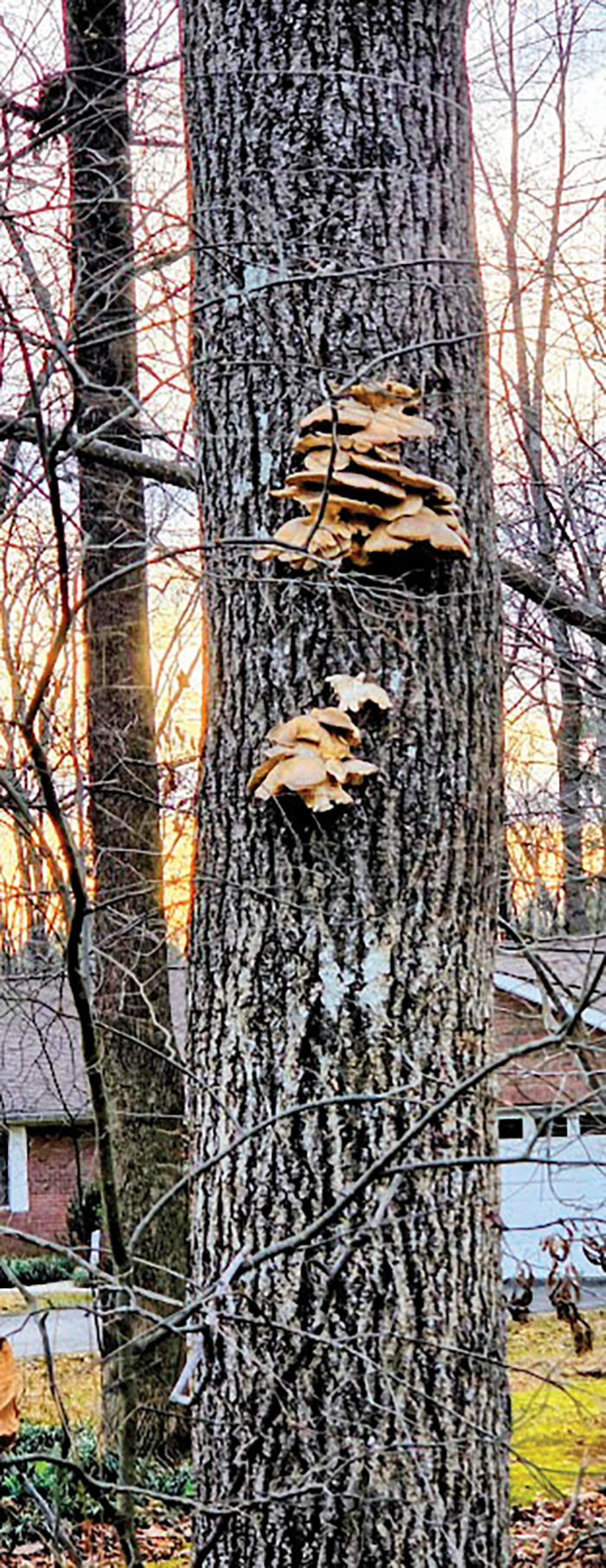
I was walking my puppy in my neighborhood earlier last week when I noticed an usual growth on the side of a large, dormant maple. The tree had a collection of mushrooms growing high on the side of the trunk. My immediate thought was it wouldn’t be too long before that tree was going to fall. My prediction was correct as the top of the tree fell two days later.
Wood-decaying mushroom fungi enters the tree through open wounds to trunks, branches or roots. The fungi invade the vascular system of the tree, initiating decomposition. The mushrooms are fruiting bodies or blooms of the decaying fungus invading the inside of the tree trunk. Those with mushrooms growing on their trunks near base and lower trunk need to keep a watchful eye as there is decomposition within the interior vascular system of the tree. Death may be a matter of a few months or many years depending on the tree species, its health, type and stage of the fungus.
Fast-growing mushroom fungi also grow very quickly from rotting roots of trees that have been removed for many years. Most homeowners with mushrooms in their lawns are often unaware of old, decaying roots that produce popup mushrooms in lawns, often in a circular pattern. There is no practical control for mushrooms in lawns or flower beds. They slowly fade away in a few days or when dry weather returns. The mushrooms can easily be removed with no problem with the turf.
Some trees have damaged areas to the base of the tree causing a deep cavern inside the trunk. The open areas allow fungi to grow within the trees’ vascular system causing decay.
Most mushrooms growing throughout Rowan County are generally non-poisonous. However, many mushrooms growing wild can be extremely poisonous. Only someone with expert knowledge can distinguish edible and poisonous mushroom species. Always be safe and never consume wild mushrooms.
Darrell Blackwelder is the retired horticulture agent and director with the North Carolina Cooperative Extension Service in Rowan County. Contact him at deblackw@ncsu.edu.