
Wake Forest players Tommy Cole, Billy Ray Barnes (on the steps) and Bob Waggoner wait out a rain delay in Omaha during the 1955 College World Series.
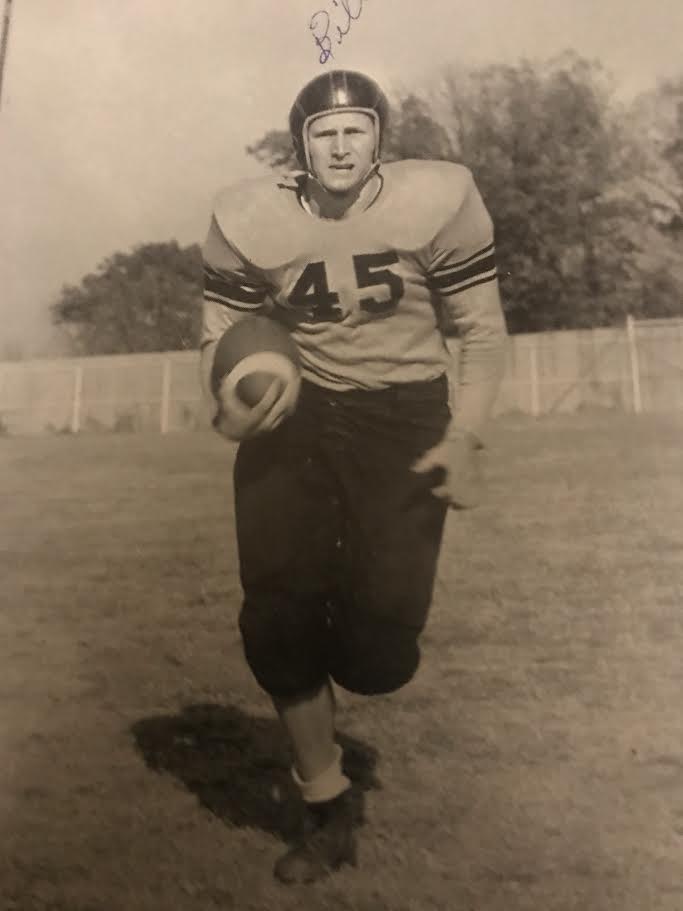
Billy Ray Barnes, Landis High, 1952.
By Mike London
Salisbury Post
LANDIS — The last pitch of the 1955 College World Series was a ground ball smashed in the direction of Wake Forest University third baseman Billy Ray Barnes, the pride of Landis High School.
Barnes made the stop, fired the ball across the diamond for the final out, and the Demon Deacons were national champions.
What Wake Forest’s baseball team accomplished in Omaha, Nebraska, with three Rowan County players in the starting lineup — Salisbury’s Frank McRae (left field) and Bob Waggoner (first base) were the others — became more appreciated as the years rolled by, as it took 60 years before Virginia won the ACC’s second national title in the sport in 2015.
Barnes had a bases-loaded triple in that climactic World Series game, a 7-6 victory against Western Michigan, and followed that three-bagger with a daring steal of home. Barnes had a celebrated college football career and an All-Pro NFL career, but he said often that Wake Forest’s baseball championship in 1955 was his biggest thrill in sports. That baseball triumph was the first national championship won by an ACC team in any sport.
Barnes died on Wednesday, Dec. 31. He was 90.
“Billy Ray Barnes is arguably the greatest athlete in Wake Forest sports history,” Wake baseball coach Tom Walter said. “Known for his toughness, Billy Ray set the standard for generations to come and his legacy will live on forever. Most importantly, Billy Ray loved Wake Forest deeply and embodied everything that we value as a community. He will be forever missed but never forgotten.”
When the North State Journal ran a series of stories in 2020 — “100 in 100” — they picked the greatest athlete of all-time from each county in North Carolina. Their choice for Rowan County was Barnes, as the high level he played at in two sports is hard to match. When the Salisbury Post picked an Athlete of the Century for Rowan County back in 2000, a staff of sportswriters reached the same verdict.
Barnes was able to retire at 60, coming back home to Landis to live out his years in the house where he grew up, the house his grandfather built. He played golf five days a week in retirement and could still hit drives a long way in his 80s. He was a regular at Warrior Golf Club for many years.
Barnes’ parents divorced when he was 9, but he was raised well by his mother and grandfather and inherited quite a bit of athletic ability from his father, who played professional baseball.
Barnes was a terrific athlete at Landis High, starring for four years in basketball and baseball and for three years in football.
He scored 1,257 points in basketball. The Post credited him with holding the Rowan County record when he graduated in 1953.
He was sensational in baseball and was one of the leaders for the Kannapolis American Legion team that won the 1952 state title.
Barnes dominated Landis football games as a running back, playing for coach Dan Hamrick, whom Barnes would always say was the best coach and disciplinarian he had at any level. As a senior in the fall of 1952, Barnes and Larry Ford captained an undefeated Landis team. The Yellow Jackets went 9-0 — beat North Charlotte, beat East Charlotte and beat Mooresville, among others. Barnes led a 13-7 victory over rival China Grove to cap a perfect season. Barnes’ final high school outing came in the East-West All-Star Game in Greensboro in the summer of 1953.
Barnes loved baseball significantly more than he did football. He liked the spectacle of performing on Friday nights, but the practices and scrimmages leading up to the games felt like work. Baseball, on the other hand, was something he enjoyed immensely, even practice. If he could have, he would’ve played baseball 24/7.
Barnes planned to play baseball for NC State, but after a medical exam a doctor cautioned him the odds were against him making the major leagues because of his poor eyesight. Barnes’ fallback plan was to play football for Duke, which had recruited him enthusiastically, but now the Blue Devils were out of scholarships. Coach Hamrick’s next call was to Wake Forest, and the Deacons were thrilled to get Barnes. They promised him he could play both sports — and it was one of the best decisions they ever made.
He was outstanding in college baseball, making All-Atlantic Coast Conference three times. He was second team once and first team twice. He was a ,300 hitter who also led the league in stolen bases.
By 1955, Barnes was a star for the Deacons on the football field as a running back and defensive back, leading the ACC in receptions and placing third nationally. “Bullet Bill” they called him in those days. Barnes wasn’t exceptionally big at 5-foot-11 and maybe 200 pounds, but his competitive spirit and toughness were hard to match.
The Atlantic Coast Conference was still in its early years in the mid-1950s, and Barnes became the league’s first 1,000-yard rusher as a senior in the fall of 1956. He was ACC Player of the Year that season and made some of the All-America teams. He was Wake’s all-time leading rusher when he graduated. The Deacons retired his No. 33 jersey.
“Billy Ray Barnes represents everything we strive to instill in our program — toughness, accountability, and an unwavering love for Wake Forest,” head football coach Jake Dickert said. “Though generations may separate today’s team from his playing days, his legacy continues to inspire our players. We honor his life, his contributions, and the standard he helped establish for Demon Deacons football.”
Barnes was a second-round pick by the Philadelphia Eagles following his 1956 football season, although he didn’t sign right away. He played his senior baseball season for Wake Forest in the spring of 1957 before he graduated.
In August 1957, Barnes competed alongside players such as Syracuse’s Jim Brown for the College All-Stars at Chicago’s Soldier Field against the defending NFL champion New York Giants.
The Eagles had a super draft in 1957 — running backs Clarence Peaks and Barnes, followed by receiver Tommy McDonald and Duke quarterback Sonny Jurgensen. The franchise would become a force in the NFL by 1960.
Barnes’ glory days in the NFL were in his first three seasons with the Eagles (1957-59). He was a key offensive player, leading the team in rushing and catching a ton of passes. He was named to three straight Pro Bowl squads.
He scored his first NFL touchdown in his rookie debut against the Detroit Lions in 1957. In 1958, he produced his first 100-yard receiving game against the St. Louis Cardinals. He had two huge rushing games in 1959 — 111 yards against the Cardinals and a career-best 163 yards against the Washington Redskins.
In 12-game seasons, Barnes amassed 529 rushing yards in 1957; 551 in 1958, and 687 in 1959. He was proudest of his 1959 season because he had over 1,000 yards that year, combining rushing and receiving.
Barnes’ stats began to decline in 1960, but that’s the season for which he is best remembered in Philadelphia as he helped the Eagles win the NFL championship. Philadelphia beat Green Bay 17-13 for the title on Dec. 26, 1960. It would be the only postseason game that Green Bay’s legendary Vince Lombardi would ever lose as a head coach.
Philadelphia’s winning touchdown sequence started with a long kickoff return to the Green Bay 38. After a holding penalty against the Packers, Barnes had a 13-yard catch, and then a 9-yard run. Then he had one of the key blocks on the run on which Ted Dean scored the winning touchdown.
Barnes’ last season with the Eagles was in 1961. After a trade, he was productive for the Redskins in 1962 and 1963, but he missed all of the 1964 season after being injured in a preseason game.
He finished his career with the Minnesota Vikings, playing his last NFL games in 1965 and 1966.
Barnes played in 98 NFL games, carrying 994 times for 3,421 yards. He totaled 153 receptions for 1,786 yards. He scored 38 touchdowns, 29 rushing and nine receiving.
Barnes was head coach of the Charleston Rockets, a minor league football team, in 1968 and coached them to an 8-3 record.
He also had an NFL coaching career as an assistant with the New Orleans Saints and Atlanta Falcons. In Atlanta, he was reunited with Norm Van Brocklin, the quarterback for the 1960 champion Eagles.
In 1975, Barnes got into the construction business in Atlanta, built 350 homes, made a bundle of money, and then lost it during an economic downturn. He retired after that and came home to Landis.
Barnes is the father of two daughters: Lani Barnes Baxter (Charlotte) and Billi Akins (Georgia) and has two grandchildren.
Barnes was inducted into the Wake Forest University Hall of Fame in 1975 and the North Carolina Sports Hall of Fame in 1979. He was in the inaugural Salisbury-Rowan Hall of Fame class that was named in 2001. The football field at Corriher-Lipe Middle School (formerly Landis High) is Billy Ray Barnes Field.
“I was deeply saddened to learn of the passing of Billy Ray ‘Bullet’ Barnes who was a close personal friend of mine,” said former Wake Forest AD Gene Hooks. “He was a fierce competitor, a proud Demon Deacon, and someone who represented Wake Forest with class. Billy’s passion for the game and loyalty to this University left a lasting mark on all who knew him. He was a great football and baseball player who helped Wake Forest win the 1955 NCAA Championship. He is the most outstanding athlete who ever wore the Old Gold & Black in both sports.”
.